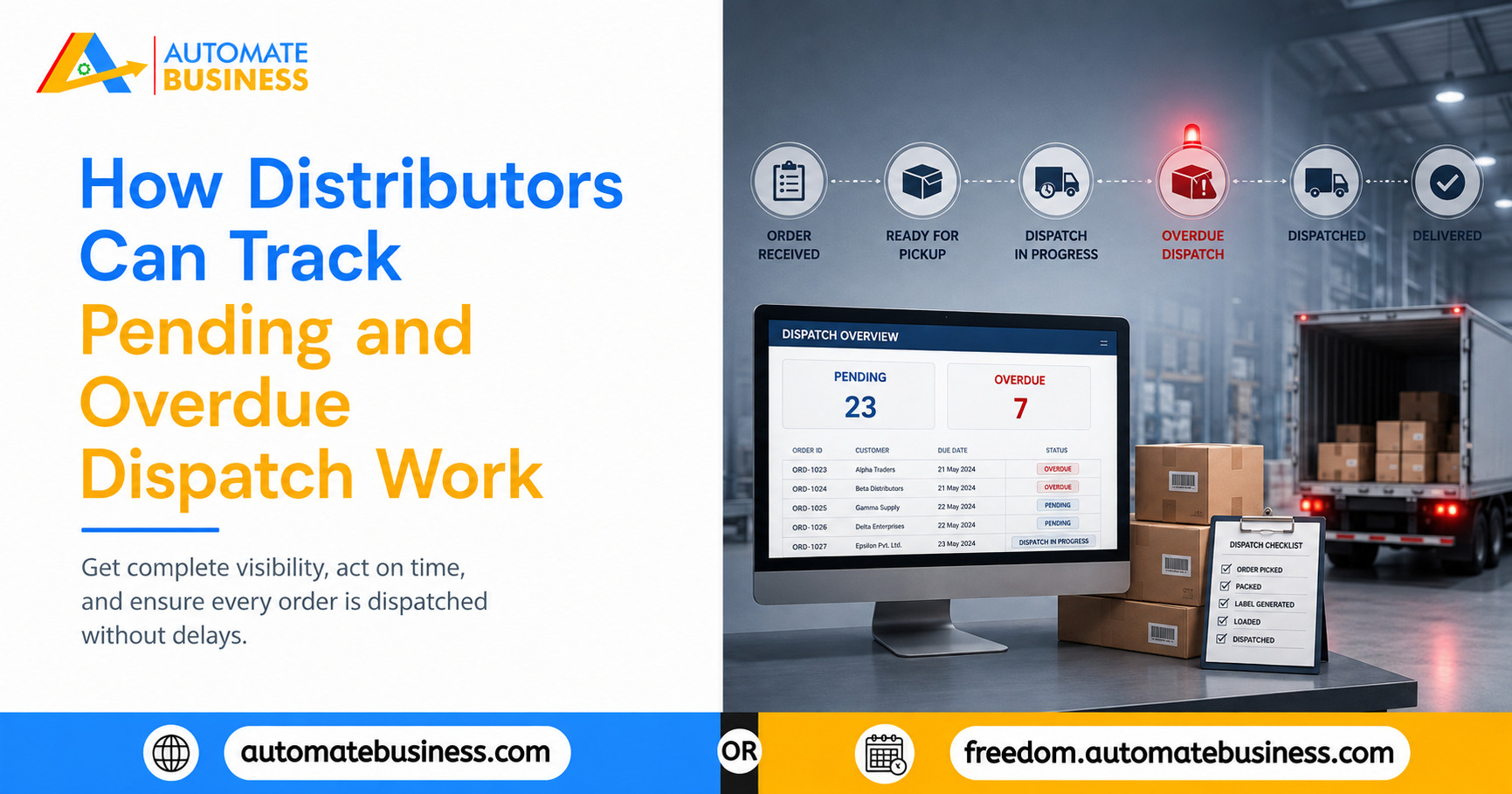
How Distributors Can Track Pending and Overdue Dispatch Work
Learn how distributors can stop dispatch delays by tracking pending and overdue work with WhatsApp reminders, dashboards, and Automate Task Management.
Join the 1 Day Live Hackathon

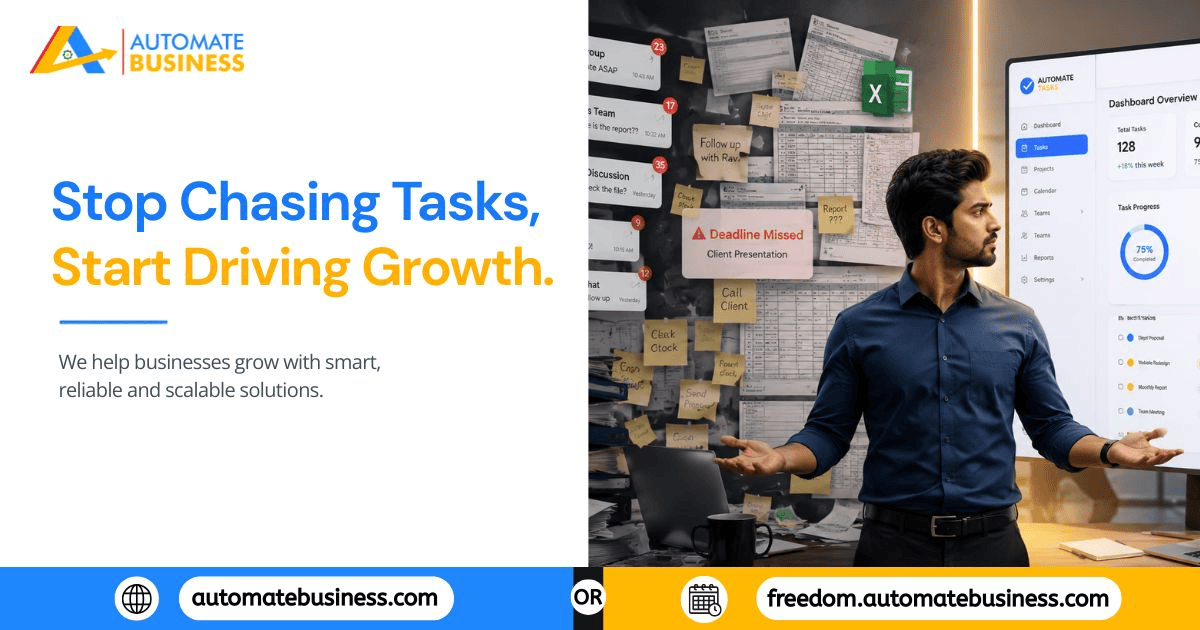
No MSME owner ever gets an invoice for "lost productivity due to WhatsApp task management." There's no monthly statement showing how much a missed follow-up cost, or how many hours went into asking "is this done?" instead of doing actual business. That's exactly what makes this cost so dangerous it never shows up as a single number, so it never gets fixed.
If your business still runs on WhatsApp groups for assignments and a shared Excel sheet for tracking, this isn't a criticism it's how almost every MSME starts. But there's a point where the system that once felt efficient starts quietly draining money, time, and trust. This article breaks down exactly where that happens, and what a purpose-built alternative like Automate Tasks actually fixes.
Why WhatsApp and Excel Feel Free But Aren't
1: The Manual Follow-Up Tax
Every "just checking" message you send is unpaid admin work. Across a team of 15-20 people, owners and managers routinely spend an hour or more a day chasing status updates that a system should surface automatically. Multiply that by every working day in a year, and you're looking at hundreds of hours spent on follow-up instead of growth.
2: Tasks With No Deadline Field
A WhatsApp message has no structured deadline, no priority tag, and no owner field. It's just text in a thread. When "send the quotation by Friday" is buried under fifty other messages by Friday morning, there's no system flagging it as overdue only a client wondering why nobody replied.
3: Spreadsheets That Are Always Slightly Wrong
A shared tracker only reflects reality the moment someone manually updates it — and starts going stale the second after. Different people log updates differently, some forget entirely, and by the time a manager reviews it, the picture is already outdated. Decisions made on stale data are decisions made on guesswork.
4: Recurring Work With No Memory
Weekly stock checks. Monthly compliance reports. Daily quality inspections. None of these run themselves in a spreadsheet-and-chat system — someone has to remember to ask for them every single cycle, and reminders depend entirely on human memory, not process.
5: Accountability That's Impossible to Prove
When there's no record of who was assigned what and when, "I didn't see the message" becomes a permanent, unfalsifiable excuse. This isn't just frustrating — it actively erodes fair performance management, because nobody can be held to a standard that was never clearly recorded.
6: A System That Breaks at Scale
A WhatsApp group with 8 people is manageable noise. The same approach with 40 people across three branches becomes unworkable chaos. The tools that got a business to its first crore in revenue are often the exact tools holding it back from the next one — because they have no structural way to scale.
What the Product Page Actually Tells Us About Fixing This
Looking at how a platform like Automate Tasks is built reveals exactly which of these six costs it's designed to eliminate — feature by feature.
Fixing the Follow-Up Tax: Fast, Structured Task Creation
Tasks can be created with a title, description, deadline, priority, and assignee in seconds. For managers handling repetitive work, AI prompts and voice commands generate tasks automatically, while bulk CSV upload handles large volumes when migrating off spreadsheets entirely. The faster task creation is, the less tempting it becomes to just type something into a chat group instead.
Fixing the Missing Deadline Field: Built-In Structure
Every task carries a deadline, a priority level, and a single accountable owner from the moment it's created — something a chat message structurally cannot offer. Sub-tasks, checklists, and templates extend this structure to multi-step or repeatable work, so complexity doesn't break the system.
Fixing the Stale Spreadsheet Problem: Live Dashboards
Instead of a static tracker that's outdated within hours, list and Kanban views, filters by assignee/status/priority/project, and dashboard scoring show real-time completion, timeliness, and backlog — automatically, without anyone manually updating a master sheet.
Fixing Recurring Work Amnesia: Automated Scheduling
Recurring tasks run on daily, weekly, monthly, yearly, or custom schedules with holiday-skip logic built in, so routine work like inspections or reports doesn't depend on someone remembering to trigger it. Reminder dates can be set separately from due dates, and the system respects each user's time zone.
Fixing Unprovable Accountability: WhatsApp and Email Reminders
Because reminders go out automatically through WhatsApp and email the channels employees already check daily there's a clear, timestamped record of when a task was assigned and when reminders were sent. "I didn't see it" stops being a viable excuse when the system shows exactly what was delivered and when.
Fixing the Scaling Wall: Role-Based Access
Admin, manager, member, and custom roles control who can assign work, view sensitive data like billing, manage users, or delegate sub-tasks. As a business adds branches or departments, this structure absorbs the growth instead of creating chaos something a flat WhatsApp group or open spreadsheet simply cannot do.
How This Plays Out Across Real MSME Functions
The product is built around how Indian MSMEs actually operate, not how a generic project management tool assumes teams work:
Operations — production handoffs and branch coordination with clear ownership instead of verbal instructions
Sales teams — lead follow-ups, callbacks, and visit tasks tracked so prospects don't go cold
Service teams — installation, dispatch, and escalation work that doesn't disappear into a chat thread
Admin & HR — onboarding, recurring audits, approvals, and policy reminders that run on schedule
Founders — a single dashboard showing what's pending, overdue, and completed — without ten phone calls
And critically, it's built across Web, Android, and iOS, recognizing that managers tend to plan and review from a desktop while field staff and branch teams update work from their phones. Both stay in sync, closing the visibility gap between what a manager assumes is happening and what's actually happening on the ground.
The Real ROI of Switching
This isn't about replacing a free tool with a paid one for the sake of modernization. It's about converting hidden, distributed costs lost hours, missed deadlines, stale data, unprovable accountability into a single, visible, manageable system. Businesses that make this shift typically see three concrete changes:
Owners stop being human reminder systems. Time spent on manual chasing drops sharply once reminders run automatically. Deadlines get respected, not guessed at. Structured tasks with clear owners reduce the number of things that quietly fall through. Growth stops creating chaos. Roles, groups, and templates absorb new hires, branches, and departments cleanly.
WhatsApp groups and Excel sheets were never built to carry the weight of a growing business's operations they were built for conversation and static record-keeping, not live accountability. The cost of stretching them past that purpose shows up quietly: in hours lost, deadlines missed, and growth held back by a system that can't scale.
If your team is ready to replace manual chasing with structure that runs itself, explore Automate Tasks and see how MSMEs across India are turning task chaos into clarity.
Get more insights every week. Join Kewal's free WhatsApp community for live sessions and automation tips.
Join 12,000+ MSMEs who automated their business. Join the 2 day live hackathon today.